Gael de Kerguenec "I paint ideas"
Gaël de Kerguenec is a French painter. 12 years in China, Gael de Kerguenec learned Chinese ink and watercolor technics with Chinese Masters. He shares his painting times between Paris, Chongqing and Chengdu catching Western and eastern inspirations. Always free of all influences, he develops his own technics, his own esthetics and his own abstract themes linked to his own interpretation and point of view about philosophy.
Gael’s background is quite unusual, tight with a strong feeling of freedom. Coming from a PhD in Linguistics, he taught in the very prestigious Paris Sorbonne University. Besides his linguistics Majoring he got 3 Master degrees in Computer Science and Computational Linguistics and worked as an Engineer for Lucent Technologies in New Jersey’s Bell Labs. In 2005, the passion of languages brought him to China where he became Director of Alliance Française in Dalian as a French Diplomat for the French Foreign Office on charge of the whole region of North East for French language trainee School and French Cultural Center. As a link between Occidental and Oriental Cultures his contact with both sides artists he became himself an artist, starting the fourth step of his amazing land eclectic life. Since 2012 he is also the CEO of his Sichuan Company Oukaida and President of the Artistic exchange Association Acadart based in Paris. His lightning artist’s career leads him to have many exhibitions all across China but also in Europe, Swiss and France.
About his Art, Gaël de Kerguenec has pushed to the extreme techniques of ink dilution and brush manipulation to approach completely unexplored and unique techniques.
In 2016 and 2017, Gael explored some new way to paint, with some secret technics of his own. For example, some paintings have been painted in fusion with the nature like the wind and the rain.
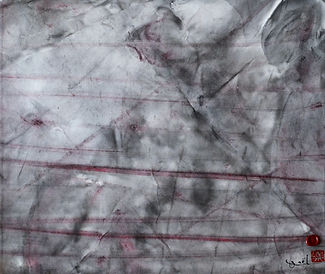
Philosophically, his art follows an approach related to the evolution of man in the world, the individual and his balance Yin Yang, his painting explored relationships with others, relationship to beliefs and then production consumption society. In Chinese philosophy and history, this is reflected in the currents of thought: Taoism, Confucianism, Buddhism and the tendencies of society towards materialism. These periods are respectively entitled: Purity, Complexity, Colors and Smog. To simplify understanding, we can see in Purity a binary Yin Yang relationship between the black ink and the whiteness of the paper in a very refined relationship created by the transparency of water. Complexity multiplies and interweaves these elements in an overall movement filled with details to the hints of arabesques. The Color arrives as an intrusion into this equilibrium of black and white, giving a new dimension and finally, the Smog obscures the whole paper where previously established forms can be perceived behind, felt or even imagined in these gray mists obtained by complex mixtures of ink.
Finally, independently of this philosophical journey, Gaël de Kerguenec created a Latin calligraphy inspired by Arabic and Cursive Chinese calligraphy. His unique and original French Calligraphy mixes dancing letters sometimes to the limit of the decipherable, a permanent creation of Letters distorted, stretched, staged in elements reminiscent of their meaning. The calligraphic texts are generally original poems of the artist. The pictorial environment can be linked to his different philosophical periods.
The paintings signature is associated with the Chines seal “LE“ (happiness) which is the Chinese name of Gael and the wax seal representing the heraldic armorial of his aristocratic family.
Aristocrat from one of the oldest noble family in France, Gael le Chauff de Kerguenec always associate his signature to his family (Le Chauff de Kerguenec) seal witnessing more than one thousand years of history contained in his armorial bearings.
Exhibitions and rewards
2017-Août : Opening of U Artist Gallery, Shanghai Raffles City
2017-Juillet : Contrat with VA Gallery Agent and Gallery Hong Kong and China « Large size »
2017-Avril : Contrat avec U Artist Agent Chine « Small size ».
2017-March: Luodai International Blossom Festival: Exhibition with Swiss and Chinese artists
2017-March: Polus International, Chengdu Longquan International Blossom Festival: Exhibition with Swiss and Chinese artists
2016-2017: Charity Art class for Blind Children: Creation and teaching by Gael’s own method
2016-December: Chongqing Tiandi, personal exhibition (U Points Pay.co)
2016-November: Contemporary Art Fair Swiss MAG Montreux (Switzerland)
2016-September: Personal exhibition in « Rise the Autumn », auction and events in September and October in partnership with Brise Gallery
2016-June: Member of Chongqing Art Society (first foreign member)
2016-May: Charity Auction sales in partnership with Huiling (Chongqing)
2016-March: Personal Exhibition at Chengdu Polus International College
2015-June: Exhibition Acadart at Dalian Municipal Library “Acadart: Freedom Art Creation”
2014-October: Exhibition and onstage painting show at Sichuan International Studies University
2014-September: Exhibition at Weifang Museum of Modern Art (Shandong Province)
2014 Creation of Acadart Association of French and Chinese artists
2013-June: Exhibition at Dalian Art Museum
2012-December: Exhibition and onstage painting show at Dalian High School of Fine Arts
2012-April-May: Weifang Guangfeng Museum
Articles, Internet and Media
China:
Television:
CCTV, Chinanews TV, Chongqing TV, Dalian TV, Liaoning TV, Weifang TV, Shandong TV, SISU TV, Polus TV
Paper Magazine:
Chongqing Fine Arts Magazine
Online Magazine:
Cncreate.org, Artexpress Yachang, Sohu, Tencent, Tudou, Runsky, Huanqiuwang, IFeng,…
International:
France: La Croix, Switzerland: SwissMag, Indonesia: Now Art, India: Strands Publishers
Website:
Publications:
Gaël de Kerguenec: “Je peins des idées” (I paint Ideas)
Acadart « Freedom Art Creation »
1. Gael’s 5 periods of Art:
His painting crosses 4 periods: Purity, Complexity, Colours, Smog, and the “Calligraphism”
1- Purity
“Paint an idea through a sign” features a single idea simply symbolized by relating black and white elements which represent a Yin Yang harmony. As the Taoism is the roots of Chinese culture, the aim is to find an individual balance.
2- Complexity
Complex assembly of signs as each sign is a Yin Yang individual, they are linked together in a social relationship. As the Confucianism teach people how to live together, the inner Yin Yang balance of each one needs a third dimension to find a balance in the dialogue with other signs or other individuals.
3- Color
The “color”, add a supernatural element to the black and white relationship. Like in Chinese history the Buddhism was introduced lately as a spiritual dimension to the previous philosophy. From the 3 dimensions complexity we have the intrusion of the time dimension.
4- Smog
The “smog”, Ideas are hidden by a smog. The smog limits the field of vision. It symbolized the Materialist dimension which comes to cover the whole previous ones. The industrial production provokes the Smog which make the painting blurred. The signification is unclear but our eye tries to see through this the harmony.
5- Calligraphism
The “Calligraphism” is the creation of a French calligraphy associated with painting. In the contrary of the other periods, some messages are clearly expressed by word but those words need concentration to be identified. Aesthetically the letters come into harmony with the various pictorial elements as some crystal clear intelligible French words, in the case of poems, they add meanings to the paintings establishing a relationship between the words and the atmosphere of the painting. A calligraphic work of eclectic styles is associated with letters. Language is to be taken as an integral dimension as space and time also adding a layer of meaning but much more intelligible in some cases.
3. Artist, Poet, And His Two Kingdoms
DEGRÉ 2 is one of the poems of the artist, Gaël de Kerguenec, who resides in China. DEGRÉ 2 is the theme of this exhibition, which presents the systematic pectination of the important works of his six stages: Purity, Complexity, Color, Smog, Calligraphism and Darkness. It fully displays the dialogue between paintings and literature of the artist, the conflict of painting tools and techniques of old and new, as well as the shared value, culture and religion of China and the West.
The traditional Chinese shui-mo has three important attributes: simplicity, symbolism and naturalness. After World War II, the rising of Art Informel in France, Germany and other European countries and the Abstract Expressionism in the United States subverted the naturalness of all classical paintings, the goal of which is not the description of representative, but the expression of emotions through point, line, surface, color, form and composition. The posture of painting, the accident of behavior, the comprehensive of materials service the experience and the idea of the artist.
Gaël de Kerguenec comes from France. He blends his unique abstract art in Chinese shui-mo. The artist fully immersed himself in the oriental philosophy when he first encountered Chinese culture. The painting was composed entirely by black and white during this period. Every brush stroke became a sign, which symbolized the permanent inner Yin Yang balance of individuals by opposition to apparent chaos. Although we can find some apparent common points with Jackson Pollock, technically the artist’s ink and watercolor techniques contrasts with the oil painting. and the philosophical approach is different. After the baptism of new culture, the artist simplified the complex relation of form and color in the abstract expressionism since Wassily Kandinsky. It became simple and pure like a neonate.
If every sign is regarded as an individual, then the relation of the signs would be a symbol of the links of all nature. How does everything remain within? Entering a new era, the wield of the pen of the artist became less of solitary, but more of moderation. The fusion of ink was a metaphor of the social relations. Besides the relation between black and white, the addition of color implied the causes of conflicts. What you see is not what you get. Then what is the nature of all things? The Artist returned to the origin of his own culture and religion. A mysterious force arose, which interposed in the disordered ink color.
In the fantastic somniloquence, the artist disassembled the structure of his mother language, and rebuild a new logic of signs. The application of extremely freehand writing mode endowed the ink style with new verve and connotation. The use of color was very prudent and restrained. Each paining was a poem not in a way of linear, but in a way of consciousness. It didn’t emphasize the function of signs, which was different from Willi Baumeister, who had implied some original images through ideograms and the shape of biological forms in his later period. Nor it underlined the modernity of the signs, which was distinct from Georges Mathieu, who had frequently used geometrical forms and a single line in color showing a progressive attitude.
Calligraphy and painting are originally an integration in the Chinese classical paintings. In this sense, Gaël de Kerguenec has already found his path in the interweave of Chinese and western art languages.
Wen Jing, Curator of Chongqing’s exhibition, 5th September 2016
4. An Art’s Linguistic to go through the language of Art
As a linguist, Gael considers Art as a foreign Language to be interpreted. A Language with vocabulary and grammar made by artistic signs.
It’s Gael’s approach to work on the situation of this cursor between the artist and the watcher.
The motivation of the sign in the painting is compared to a balance where the sense oscillates between the figurative and the abstract, titles or similitudes will drive the sense closer to some possible figurative meanings. A title given by a watcher will drive the sense into his world. A title by the artist will dictate a signification.